
Pipestone County Supervision Types
Start with the legal source of control. Probation is imposed by a court and normally lets a person remain in the community under stated terms instead of, or after, local custody. Supervised release is the community part of an executed Minnesota prison sentence. The person has left prison but remains under Minnesota Department of Corrections jurisdiction. Parole applies to narrower statutory groups, including certain life sentences and older indeterminate sentences. It should not be used as a broad label for everyone released from a Minnesota prison.
Pipestone County Corrections/Probation supervises or coordinates adult felony, misdemeanor, gross-misdemeanor, juvenile, probation, and supervised-release work described by the county. The Minnesota DOC handles state commitments and ordinary supervised release. The Minnesota Supervised Release Board decides release and final-discharge matters only for the populations assigned to it by law. These systems can touch the same person at different stages, but their records are not interchangeable.
| Status | Who imposes or manages it | Best verification route |
|---|---|---|
| Probation | District court, with local corrections supervision | Public court order plus Pipestone County Corrections/Probation routing |
| Supervised release | Minnesota DOC as part of an executed state sentence | DOC PublicViewer while the person remains under DOC jurisdiction |
| Parole or board release | Minnesota Supervised Release Board for defined cases | Board schedule and approved minutes, then DOC records if needed |
| Final discharge | The authority that held correctional jurisdiction | Discharge order, certificate, or maintained agency record |
- Supervised release
- The community portion of a Minnesota executed sentence under continuing DOC jurisdiction.
- Parole
- A release process for limited statutory groups, not a synonym for every prison release.
- Absconder
- A person alleged to have violated release and avoided supervision authorities.
- Final discharge
- The end of the correctional jurisdiction documented by the controlling authority.
Check Pipestone County Supervision
No single public search covers every Pipestone County parole and probation case. The correct sequence depends on whether the person received local probation, served a state prison term, or belongs to a Supervised Release Board population. A current jail roster is not the right tool once physical county custody ends. Follow the legal chain instead.
- Open the public criminal case through Minnesota Court Records Online. A case number gives the strongest search. Read the judgment, sentence, probation order, later violations, and discharge entries that are public.
- For local probation or help finding the responsible route, contact Pipestone County Corrections/Probation. Its webpage is a contact path, not a public person-name database.
- For a person committed to the Commissioner of Corrections, use the Minnesota DOC search gateway and PublicViewer. It includes people released from prison who are still supervised.
- If a life, legacy, or designated early-release case is involved, check the Supervised Release Board schedule and approved minutes. A calendar date is only a review date.
- Use the county warrant report or DOC fugitive information only when a possible alleged violation makes that narrow check relevant. Neither list supplies a full supervision history.
A missing result needs care. Pending criminal cases without a conviction may not appear in remote name results, and PublicViewer does not promise a permanent record after final discharge. When a maintained state record is needed, DOC Records Management can explain its request process at 651-361-7330 or CO-Records.DOC@state.mn.us. For the broader release trail, the Pipestone County released-inmate search path separates county, court, and state records.
Note: A public search result can confirm a displayed status, but silence from one system does not establish that supervision ended.
Pipestone County Probation Contacts
The county provides a direct human route where no local supervision name-search exists. Staff assignments are divided by case class. Callers should give enough case context to reach the right office, while recognizing that not all supervision facts are public. The office supports District Court investigations and supervises or coordinates the local programs listed on its official page.
Pipestone County Corrections/Probation
Courthouse complex
416 South Hiawatha Avenue
Pipestone, MN 56164
General county hours: 8:00 a.m. to 4:30 p.m.
Main line: 507-825-1125
Fax: 612-473-5437
Misdemeanors and juveniles: Jeff Arendt, 507-825-1126, jeff.arendt@state.mn.us
Felonies: Brad Larson, 507-825-1127, brad.j.larson@state.mn.us
The county page does not post walk-in reporting instructions or a public list of people supervised. Its contact assignments are still useful. A misdemeanor or juvenile question follows one route, while a felony question follows another. A public court file can help identify the case category before the call.
The official Pipestone supervision page is the source to recheck before relying on a staff name or number. Assignment and routing details can change.
The successful manifest capture of the county Corrections/Probation contacts shows how Pipestone divides the local route.
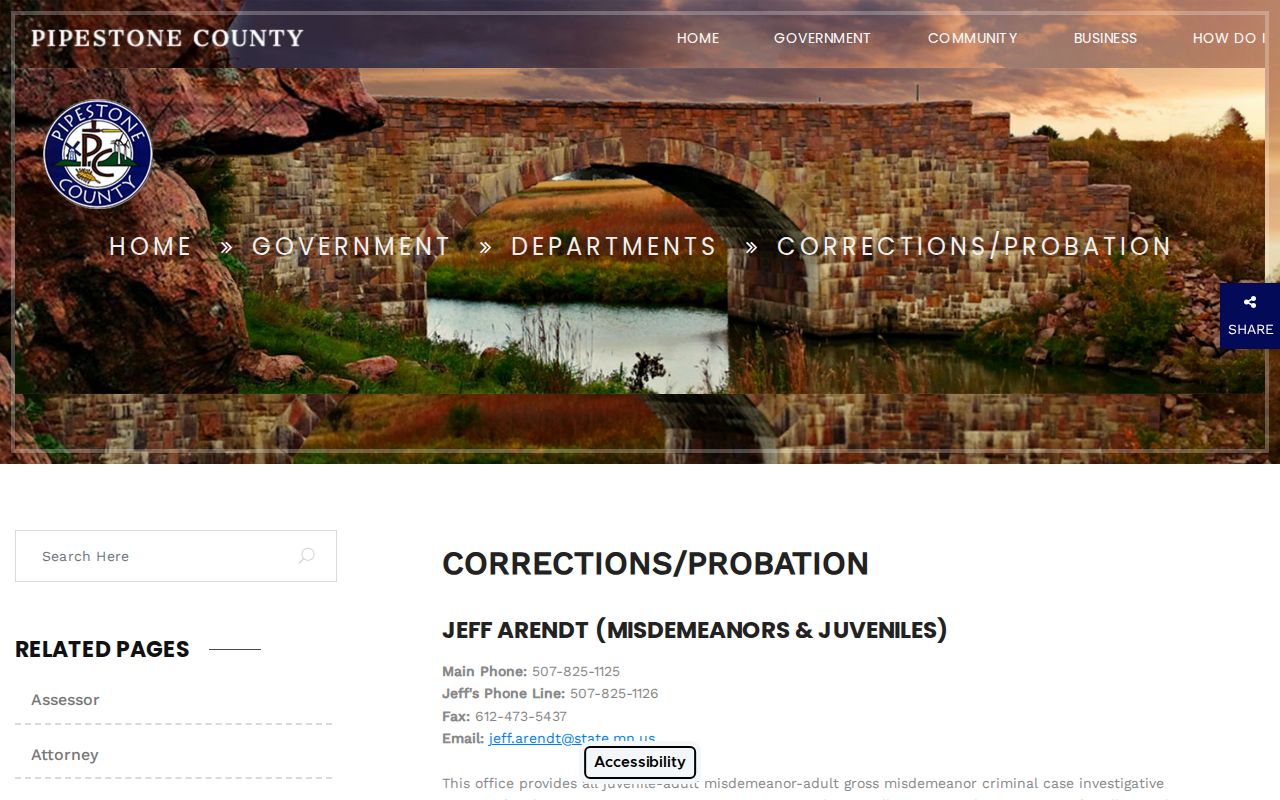
Use the page to choose a contact, not as proof that a named person is or is not under supervision.
Pipestone County Supervision Warrants
Pipestone’s dedicated active-warrant report is a useful post-custody clue. It displays warrant number, name, age, warrant date, bond or bail, offense level, and a description. Reviewed descriptions included probation violations and violations of release conditions. That makes the report relevant when there is a sound reason to check for a new warrant after release.
Its limits matter just as much. A warrant match does not reveal the original release date, prove a current supervision assignment, or give the full history of an alleged violation. An absence does not prove compliance. A listed bond figure applies to that warrant, not to every Pipestone County case. Confirm the source record with the court or responsible corrections office.
The official Pipestone active-warrant report is shown in the successful local capture.
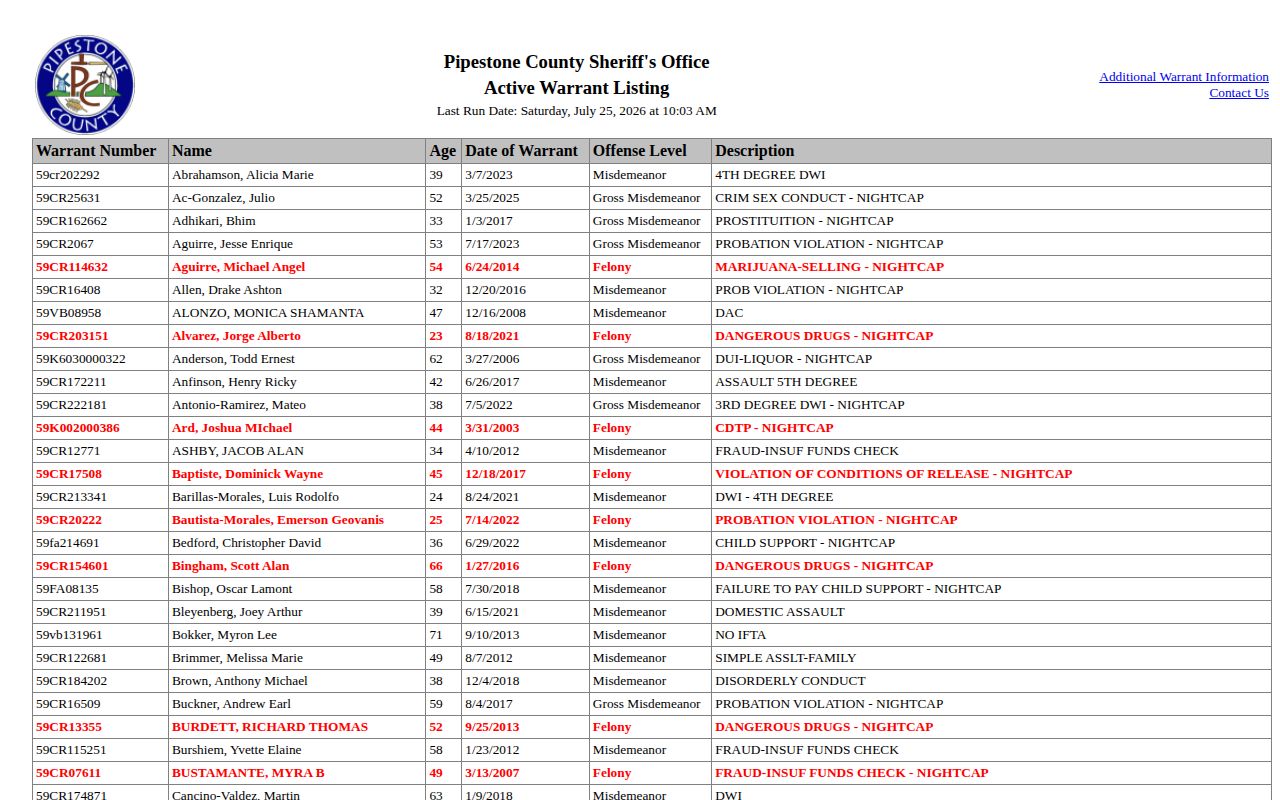
The displayed fields can identify a reported warrant, but they do not turn the report into a parole or probation roster.
Pipestone County DOC Supervision
A person who leaves a Minnesota prison on ordinary supervised release remains under DOC jurisdiction. PublicViewer is therefore relevant even though physical prison custody has ended. Search by first and last name or by a numeric MNDOC Offender ID no longer than six digits. The portal can search conviction-associated former names and aliases, while its results use the current updated DOC name.
Read each status and date label literally. “Released but supervised” is not final discharge. If the person left the Pipestone County Jail through a transfer to state custody, the Sheriff transfer record establishes the county segment. The DOC record establishes the later state segment. One cannot reconstruct the other. A person jailed only on a county matter does not appear in PublicViewer merely because Pipestone held them.
DOC custody and community-supervision notifications use Minnesota Haven, not county-jail VINE. Haven can notify registered recipients about release planning, agent assignment, supervision changes, sentence expiration, and other listed events. It is a notification route rather than a public historical locator. Minnesota VINE remains the county-jail event network.
Pipestone County Parole Review
The Minnesota Supervised Release Board began work in 2024. Its jurisdiction under Minn. Stat. § 244.049 includes defined life sentences with release eligibility, older indeterminate sentences, and specified early-release cases. Most modern determinate sentences do not require a discretionary parole grant. For those ordinary cases, prison release starts the supervised community part of the executed term.
The Board hub publishes meeting details, a review schedule, agendas, recordings, and approved minutes. The schedule can show an offender ID, scheduled review date, name, parole-eligibility date, offense, and annotations. It does not promise release. Approved minutes are the direct published results source because they state the motion, outcome, directives, and votes. The hub keeps past materials for roughly ninety days, so an older decision may require a DOC data request or the DOC legislative-report catalog.
A parole-eligibility date is the earliest legal point at which a covered person may be considered. The Board can assign a projected release date or continue review with directives, and it cannot authorize release before the governing eligibility date. This narrow process must remain separate from routine Pipestone County probation.
Pipestone County Reentry Programs
Local reporting documents the Pipestone-Murray part of Minnesota Cornerstone Drug Court, including one local graduation report and additional treatment-court coverage. Treatment court can connect court supervision, treatment, and structured progress, but a news report about a graduation does not establish current eligibility, enrollment steps, or an individual’s status.
Pipestone County Court Administration and Corrections/Probation are the proper navigation contacts for current local process. A person’s court order remains the controlling source. Local news adds dated context, not a supervision record.
Note: Treatment-court reporting shows a local reentry setting, while admission rules and present participation must come from the responsible office.
Pipestone County Supervision Discharge
Supervision ends through the authority that controls it. A probation discharge appears through a court order or case record. A state sentence can move from prison to supervised release and later reach sentence expiration or final discharge. Legacy parole law also describes a final-discharge certificate and related record. Leaving a jail or prison is therefore not enough to prove that all correctional control has ended.
Use the public court file for local probation, DOC data for a state sentence, and Board materials only for cases within Board jurisdiction. If PublicViewer no longer returns a person after final discharge, the missing result does not prove the date. Request the maintained record. Sealed or expunged court material can also change public access without erasing the underlying event.
Conditions and responses vary by the controlling order. An alleged violation may lead to a warrant, a court hearing, discipline, or a return to custody, but a public list is only one fragment. The order, agency record, and later disposition provide the soundest account.